


In today’s globalised economy, many businesses look for ways to reduce costs by importing products from Asia. A low catalogue price may appear attractive, particularly when placing large-volume orders. However, it does not always translate into genuine savings.
When purchasing plastic household goods, the final cost depends on much more than the unit price alone. For wholesalers, distributors and retail chains, other factors are equally important, including consistent product quality, reliable delivery schedules, flexible terms of cooperation and the ability to replenish stock quickly.
This is why a growing number of European businesses choose to work with local manufacturers such as AGD Lipiecki, a Polish manufacturer of plastic household goods.
The purchase price is not the total cost of the product
When comparing an offer from a Polish manufacturer with imported products, the unit price should not be the only deciding factor. A product sourced from a distant market may appear less expensive in the catalogue, but its final cost must also include transport, customs clearance, warehousing and the administration of the entire logistics process.
Businesses must also consider how long their capital will remain tied up in goods that have been ordered but are not yet available for sale. Imported products often need to be purchased well in advance, long before they reach the warehouse and can be introduced to the market.
The most common hidden costs of importing
- sea, rail, air or road freight,
- customs duties, taxes and clearance charges,
- import documentation and administrative costs,
- cargo insurance,
- storage of large product volumes,
- exposure to exchange-rate fluctuations,
- quality-control and shipment-inspection costs,
- losses caused by defective or non-compliant products,
- costs resulting from delays and stock shortages.
Once all of these expenses have been taken into account, the difference between imported products and goods supplied by a Polish manufacturer may be considerably smaller than the initial quotation suggests.
The risk of delays and supply disruptions
In wholesale distribution, price is important, but product availability is equally critical. Even an attractive product cannot generate the expected sales if it is unavailable during a period of peak customer demand.
International imports depend on numerous factors over which the wholesaler has no direct control. Port congestion, container shortages, changes to freight schedules and customs-clearance complications may all result in delivery delays.
Working with a Polish plastic household goods manufacturer helps reduce these risks. A shorter supply chain makes it easier to plan orders, replenish stock quickly and respond to seasonal changes in demand.
Consistent quality across plastic household products
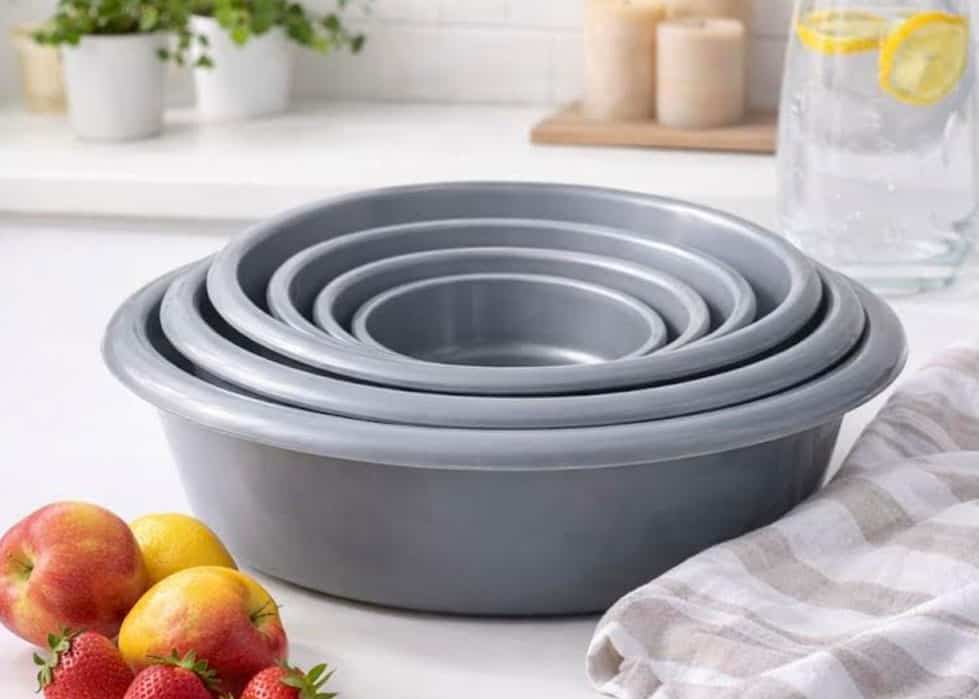
In the household-goods sector, the quality of the plastic directly affects the durability, appearance and everyday usability of the finished product. This applies to products such as plastic bowls and basins, buckets, storage containers and other accessories used in kitchens, bathrooms, gardens, households and commercial premises.
One of the risks associated with importing is inconsistent quality between successive production batches. Products that look almost identical in photographs may differ in wall thickness, flexibility, surface finish, handle durability or colour consistency.
For wholesalers and retailers, these differences may lead to customer complaints, returns and reputational damage. When one batch differs from the previous one, it becomes more difficult to maintain a consistent product range and build customer confidence in the products being sold.
In wholesale distribution, product consistency is just as important as price. Customers returning for the same model expect the same quality, colour and functionality.
Direct communication with the manufacturer
One of the most important advantages of working with a local manufacturer is direct communication. Wholesalers do not need to exchange information through multiple intermediaries or wait for responses from suppliers operating in a different time zone.
Direct contact makes it easier to confirm product availability, lead times, packaging requirements, colour options and the details of larger orders. It also allows potential discrepancies to be resolved more quickly and enables both parties to find a solution suited to the specific situation.
Efficient communication is particularly important in B2B cooperation. It enables businesses to plan deliveries, promotional campaigns, stock for new retail locations and seasonal increases in order volumes more effectively.
Flexible order quantities
Importing frequently requires businesses to purchase large quantities of a single product. For smaller wholesalers and retailers, this may involve high initial expenditure and the need to allocate substantial warehouse space to stock storage.
Working with a Polish manufacturer provides greater flexibility. Order quantities can be adjusted to current sales levels, available warehouse capacity and the purchasing preferences of the company’s customers. This also makes it possible to test new products without immediately investing in a very large shipment.
Depending on the agreed terms of cooperation, customers may place both smaller orders and larger production orders intended for wholesalers, distributors and retail chains.
A faster response to changing market demand
Demand for plastic household goods can vary according to the season, weather conditions, promotional campaigns and changing customer requirements. In such situations, the ability to increase order volumes quickly provides a significant competitive advantage.
Shorter delivery times help wholesalers reduce the risk of overstocking. Instead of purchasing enough stock for several months in a single shipment, businesses can replenish their warehouses more frequently based on actual sales performance.
This approach supports better cash-flow management and makes the product range easier to control. It also enables products with lower sales volumes to be replaced more quickly with models that are generating stronger customer interest.
Custom colours, packaging and product branding
Direct cooperation with a manufacturer makes it possible to adapt the product range more closely to the needs of a particular customer. Subject to the type and volume of the order, this may include custom colours, packaging formats, labelling or product branding.
This type of cooperation is particularly valuable for retail chains, distributors and businesses developing products under their own brand or private label. Direct communication with the manufacturer makes it easier to confirm technical possibilities, minimum order quantities and production terms.
The advantages of working with a Polish plastic household goods manufacturer
AGD Lipiecki is a Polish manufacturer of household goods made from plastic. The company’s product range includes plastic bowls and basins, buckets, storage containers and practical household accessories designed for everyday use.
Cooperation with a Polish manufacturer provides wholesalers, retailers and distributors with a number of important benefits:
- a shorter supply chain and easier stock planning,
- shorter order lead times compared with intercontinental shipping,
- direct communication with the company responsible for manufacturing the products,
- greater flexibility in order quantities,
- consistent quality across successive production batches,
- the option to discuss custom colours, packaging, labelling or branding, depending on the product and order volume,
- faster replenishment of out-of-stock products,
- more efficient handling of potential complaints or product issues,
- a product range better suited to the requirements of European customers.
Which businesses benefit most from working with a Polish manufacturer?
A local supply model is particularly suitable for businesses that require regular product availability but do not want to tie up substantial capital in a single large order.
- household-goods wholesalers,
- general retailers and variety stores,
- retail chains,
- regional distributors,
- online retailers,
- companies supplying households, businesses and commercial facilities,
- businesses developing products under their own brand or private label.
Is importing always the less cost-effective option?
Importing is not necessarily the wrong solution in every situation. It may be commercially viable for companies that regularly order very large volumes of standardised products and have their own logistics, warehousing and quality-control resources.
For many wholesalers, however, the ability to replenish stock quickly, reduce supply-chain risk and communicate directly with the supplier is more valuable than achieving the lowest possible unit price. Before making a decision, businesses should therefore compare not only the purchase price but also the total landed cost of the order.
Trust built on manufacturing experience
As an experienced manufacturer of plastic household goods, AGD Lipiecki works with customers who value reliable cooperation, consistent product quality and continuity of supply.
Our knowledge of the Polish and European markets allows us to understand the requirements of wholesalers, retailers and distributors. Direct cooperation makes it easier to respond to changes in sales, arrange repeat deliveries and develop the product range in line with customer expectations.
Instead of relying entirely on a long and difficult-to-control international supply chain, businesses can choose a reliable manufacturing partner based in Poland.
Are you looking for a Polish manufacturer of plastic household goods?
AGD Lipiecki supplies plastic household products for wholesale distribution. Contact us and tell us about your business profile and the products you are interested in. We will provide information about product availability, order fulfilment and the available terms of cooperation.

